Stephen Dansiger

psyd mft

323-248-7475

Punk drummer then Songwriter then Dharma Practitioner then Social Justice Educator then EMDR/Trauma/Addiction Therapist then Author/Podcaster now simultaneously...

My Presentation at the EMDRIA Conference and.... Addiction

As part of my preparation to speak at this year's 2016 EMDRIA Conference in Minneapolis, I have been journaling my thoughts on the different aspects and hopeful impact of my presentation. For more information on the conference, click here. For additional journal entries, click here.

My Presentation at the EMDRIA Conference and.... Addiction

We live in difficult but exciting times – as the role of trauma in many different disorders and dilemmas has become apparent, we have the unique opportunity to focus our attention on trauma and trauma recovery being at the center of the healing path. This is particularly true for the millennia old dilemma of how to best treat addictions.

Many over the years have pointed to the importance of trauma recovery and trauma resolution in the process of addiction recovery.  Even those that believe that trauma recovery is crucial have wildly varying opinions as to how and when that should happen. That conversation is starting to skew toward trauma being an integral aspect of the addiction experience, and recovery from traumatic experiences and their consequences being a game changer in addictions recovery.

Having sat with a great number of addicts over the last couple of decades, I have noticed that a vast majority of recovering addicts have some kind of childhood trauma history. There are those that know they have had difficult pasts, and others who describe terrible things but swear that they are not affected by them. For those addicts who did not have trauma in their early years, almost certainly they took actions in their active addiction that were often traumatic in nature.

This being the case, it would seem that discovering a method or methods through which we could successfully stabilize the recovering addict, and then reprocess their traumatic memories, would be the most potent path to recovery. For the last 27 years I have been practicing Buddhist mindfulness meditation, including living at a monastery for a year. When I became a therapist, mindfulness of course informed my theoretical orientation and my methods. I have found nothing more powerful than Buddhist psychology and Buddhist practice as a means to greater understanding and to healing. That is why I helped Noah Levine develop the Los Angeles based treatment program based on his book Refuge Recovery, and he in turn trusted me to move forward with EMDR as a guiding orientation for our therapeutic work, so that we might effectively reprocess trauma using this highly researched therapy.

If the goal is to be able to reprocess traumatic memories in order to prevent relapse rather than to contribute to it once again, it is important that we be extremely mindful of the stabilization phase of recovery. My stabilization strategy is grounded in Buddhist mindfulness, and this and other addiction recovery methodologies all fall within the scope of the first two phases of EMDR therapy. Many people think of EMDR as "Follow my fingers" (or lights or tones), but in fact there is much to be done before reprocessing memories. From stabilization and resourcing we can then move toward reprocessing these troubling memories in order to support long term addiction recovery.

This is all deeply grounded in EMDR therapy, including the Adaptive Information Processing Model upon which it is based. We may be on the verge of a much more effective approach to treating addiction, by changing the short and long term goals of treatment, and by leaning into the trauma recovery aspect of the addictive cycle.

My next post will address the implications of this theory and practice for addiction treatment centers...


 

Anna David's "You've Got Issues" Podcast: PJ's On A Plane...

My good friend Anna David has a new podcast called You've Got Issues, where she talks to artists and others about their pet peeve issues... and then she hands it off to a panel of experts to look at the underlying causes and conditions that may inform these pet peeves...

I recorded several of these with Anna as one of her experts breaking down the issues focused upon in the interview... other experts include Jeff Kober, Noah Levine and a 10 year old named Archer... I had a great time recording these, and the first one regarding people wearing their pajamas on a plane is up and available...

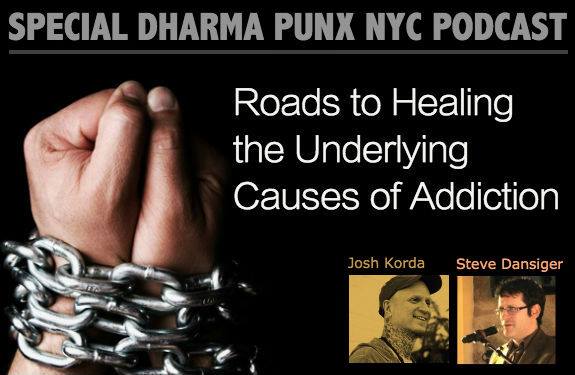
Interview on the Refuge Recovery Podcast

Dave Smith and Noah Levine are rolling out the Refuge Recovery podcast... until now it has featured meditations only... they have put out the first of many interviews to come, this first one with me about my recovery journey, my Buddhist journey and practice, and my excitement about Refuge Recovery Centers and the future of treatment... on the eve of the 2nd Refuge Recovery Conference...

Mindfulness and EMDR: From Addictions to Body Image Issues and Beyond

Heading out to Claremont tomorrow to give a talk on the use of Mindfulness and EMDR therapy in the treatment of Body Image issues and Eating Disorders. This is an exciting time for me, as the training of all the clinicians at Refuge Recovery in EMDR is almost complete, and my presentation at the EMDRIA Conference in August has been accepted and scheduled. My colleague Dr. Jamie Marich and I are forging ahead with our book on Mindfulness and EMDR. The theory and ongoing practice of using the 8 phase protocol as a way of seeing cases at an addictions rehab truly seems to be making a difference, and I am looking forward to initial research and ongoing research on the subject.

When I was invited to give this talk in Claremont, it struck me that body image difficulties make perfect targets for trauma reprocessing, and it also became clear that this 8 phase protocol template for running an agency could have even wider implications. I am going to continue to present on the topic, write about the topic, and see what we all can do to hopefully better the lives of those who struggle with trauma related disorders.

More to come!

Inaugural Clinical Dharma Retreat

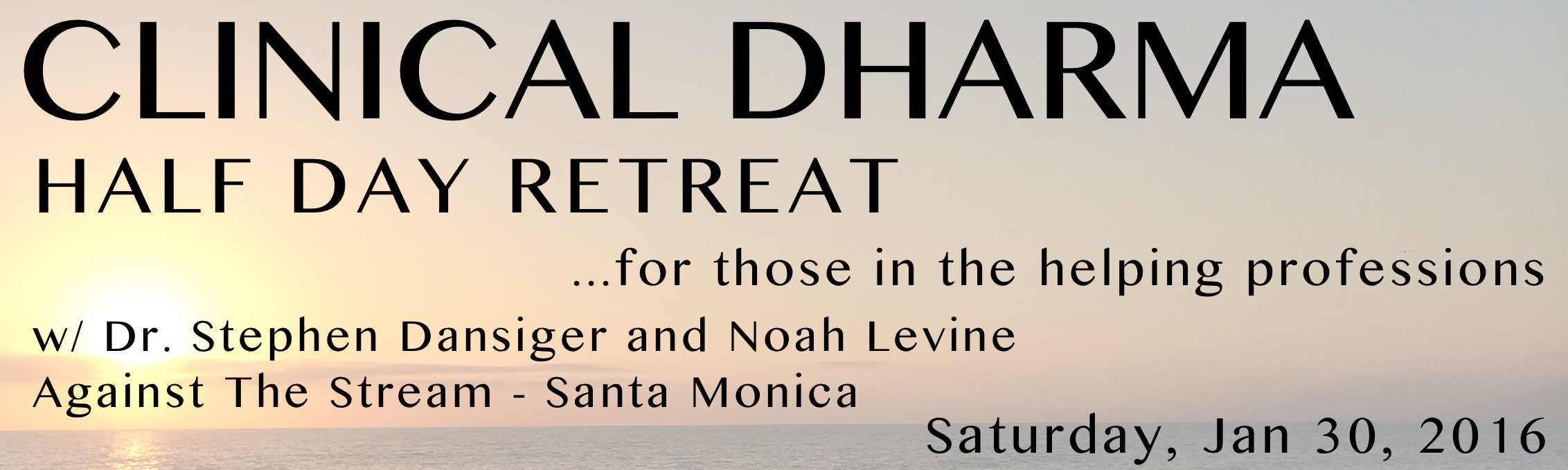
Join the inaugural Clinical Dharma Retreat for helping professionals with Dr. Stephen Dansiger and guest Noah Levine, followed by a 12 week class series in person or online.

Saturday, Jan 30th, 2016 (10AM - 1PM) @ Against The Stream - Santa Monica
1010 Colorado Blvd, Santa Monica CA
Free (Dana optional)

Clinical Dharma is a series of 12 classes designed by Dr. Stephen Dansiger to help helpers to infuse their self care, and their care of others, with the 4 Noble Truths and the 8 Fold Path of the Buddha.  Also featured as part of Clinical Dharma is the opportunity to go on short retreats with Dr. Steve and guest teachers, where the focus will be on how our work practice is fed by our practice of Buddhist mindfulness.  These workshops can be found both in person and online.

All attendees of this first retreat will be given a 10% discount for one year on any Clinical Dharma classes, retreats or products.

Please RSVP on the calendar event page: